Report No.
#TEST-9
Rate this Script
Share Report
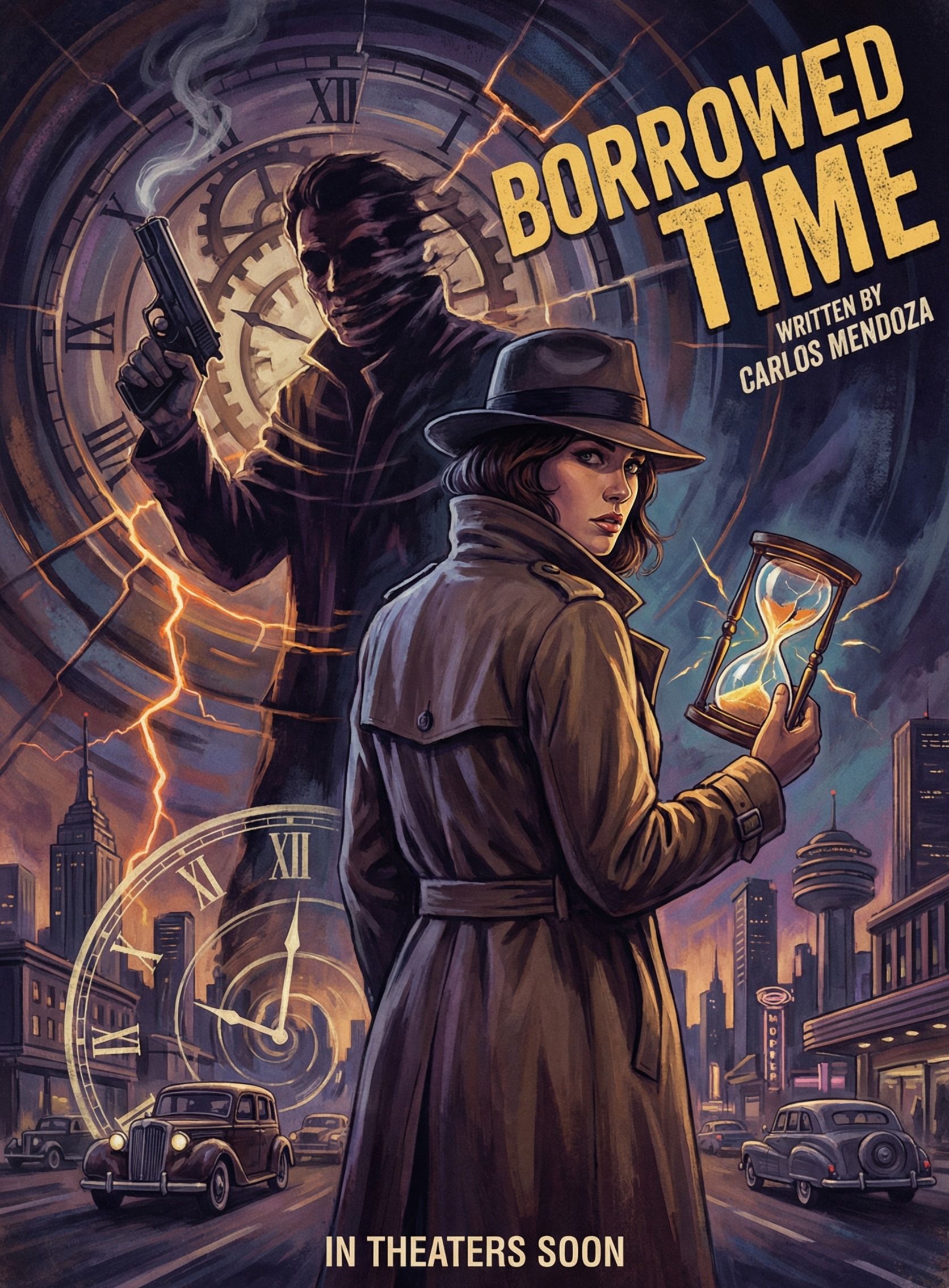
Borrowed Time
"A time-travel insurance adjuster investigates her own death claim, discovering she has 72 hours to prevent her murder - but saving herself might collapse the timeline...."
Synopsis:In 2048, time travel exists but is strictly regulated by insurance companies who prevent paradoxes. Lucia Mendez works as an adjuster for Temporal Mutual, investigating suspicious death claims to ensure no one is gaming the system by preventing their own demise. It's boring, bureaucratic work - until she receives a file for her own death, scheduled for 72 hours from now: murdered in her apartment, killer unknown. Protocol dictates she recuse herself, but Lucia sees a loophole. She's the only adjuster assigned to her sector this week. If she doesn't investigate her own case, no one will, and she'll die. She begins following the procedural steps, interviewing her future neighbors who heard the murder, examining crime scene photos from her yet-to-be-killed corpse. The investigation reveals her murder is connected to a pattern of adjuster deaths she's been investigating - adjusters who got too close to discovering a massive temporal fraud scheme. Someone is using fake death claims to funnel money through time, and they've been eliminating investigators. Lucia's murder isn't random; it's a hit. As she closes in on the perpetrators, Lucia discovers the horrible truth: her boss Marcus is running the scheme, and he's not just stealing money - he's creating a pocket timeline where certain deaths (including his own daughter's) never happen, funded by the fraud. Every prevented death creates tiny fractures in causality. If Lucia stops him, thousands die who should have been saved. If she doesn't, the timeline collapses entirely. With 24 hours left, Marcus offers Lucia a deal: join his pocket timeline. In that reality, she doesn't die, her brother (who died of an overdose) is still alive, and she can build the life she always wanted. All she has to do is file her own death claim as "natural causes" and look the other way. The climax is existential: Lucia must choose between living in a lie or dying in truth. She realizes the pocket timeline is a mass delusion - everyone in it knows they're cheating death, and it's made them hollow. She destroys the fraud database, erasing the pocket timeline and ensuring her own murder happens as scheduled. The final scene is devastating: Lucia goes home, knowing she'll die in hours. But she's left evidence that will bring Marcus down after her death. As the killer arrives, she sees it's her future self from the pocket timeline, trying to eliminate the version of herself who chose truth. They fight, and Lucia allows herself to die, collapsing the paradox and saving the timeline. The ending reveals this was always meant to happen - she was always the key to saving everyone.
Performance Metrics
Executive Analysis
Execution Evaluation
Lucia is a strong protagonist with clear arc from bureaucrat to martyr. The procedural investigation structure provides satisfying framework. Time-travel rules are internally consistent, though complex - may require careful visual exposition. Dialogue is sharp. Pacing is tense, maintaining thriller momentum while building philosophical questions. The climax is bold and commits to its dark ending. Minor concerns: some supporting characters feel underdeveloped; the pocket timeline mechanics could use clearer explanation; the final twist may feel too clever for some viewers.
Market & Audience
Moderate commercial potential. The time-travel thriller genre has proven audience, but the insurance adjuster premise may be harder to market than traditional action setups. Budget moderate ($30-45M) requiring solid VFX for temporal elements. Appeals to viewers who enjoy puzzle-box narratives and moral complexity. International appeal through Latinx protagonist and noir aesthetic. Better suited for streaming than theatrical given niche appeal, but strong potential for devoted genre audience.
Commercial & Prestige
Moderate appeal requiring smart positioning. Time-travel thriller genre proven with 'Looper,' 'Predestination,' 'Dark.' Insurance adjuster premise challenging to market versus conventional heroes. Latinx noir provides differentiation and representation. $30-45M budget for mid-tier genre. Fundamentally streaming play - Netflix, Amazon, Apple seeking sophisticated diverse content. Philosophical truth-versus-lies questions resonate. Dark ending bold but may limit mainstream. Genre festivals could build buzz. Cult following potential among intelligent sci-fi audiences. Key is managing expectations.
Pacing & Structure
Strong thriller momentum with 72-hour countdown. Act one establishes time-travel insurance efficiently before death claim hook launches investigation. Investigation beats well-structured, balancing procedural detail with suspense. Adjuster deaths pattern revelation accelerates act two into conspiracy. Marcus's fraud and pocket timeline raise philosophical stakes without slowing drive. Final 24 hours provide character-driven tension. Act three accelerates toward dark climax. Fight with future self is action and existential crisis. Minor temporal mechanics exposition could condense. Excellent genre momentum with philosophical weight.
Cinematic Potential
Substantial visual potential blending noir with time-travel sci-fi. 2048 feels near-future believable. Investigation provides noir procedural visuals with unsettling own-murder twist. Crime scene photos of own corpse disturbing. Pocket timeline sequences use subtle color grading - world feels slightly off. Insurance office as corporate dystopia managing reality. Latin noir urban aesthetic brings cultural texture. Climactic fight allows visual doubling effects. Temporal collapse rendered with controlled VFX serving philosophy. Comparable to 'Looper' in time-travel noir.
Theme & Innovation
The insurance adjuster angle is genuinely novel - bringing bureaucratic mundanity to time-travel creates interesting contrast. The central conceit of investigating your own death is compelling. The pocket timeline fraud scheme is clever and provides ethical complexity beyond standard time-travel paradoxes. The killer being future-self from alternate timeline is dark and thematically rich. Some familiar time-travel elements, but the execution provides fresh angles. Latin noir influence distinguishes it from typical sci-fi fare.
"Intelligent, dark sci-fi thriller that treats viewers as smart. The Latin noir aesthetic provides distinctive flavor. Would appeal to directors with visual style and philosophical interests. Not a mainstream blockbuster, but strong potential for critical recognition and cult following."